
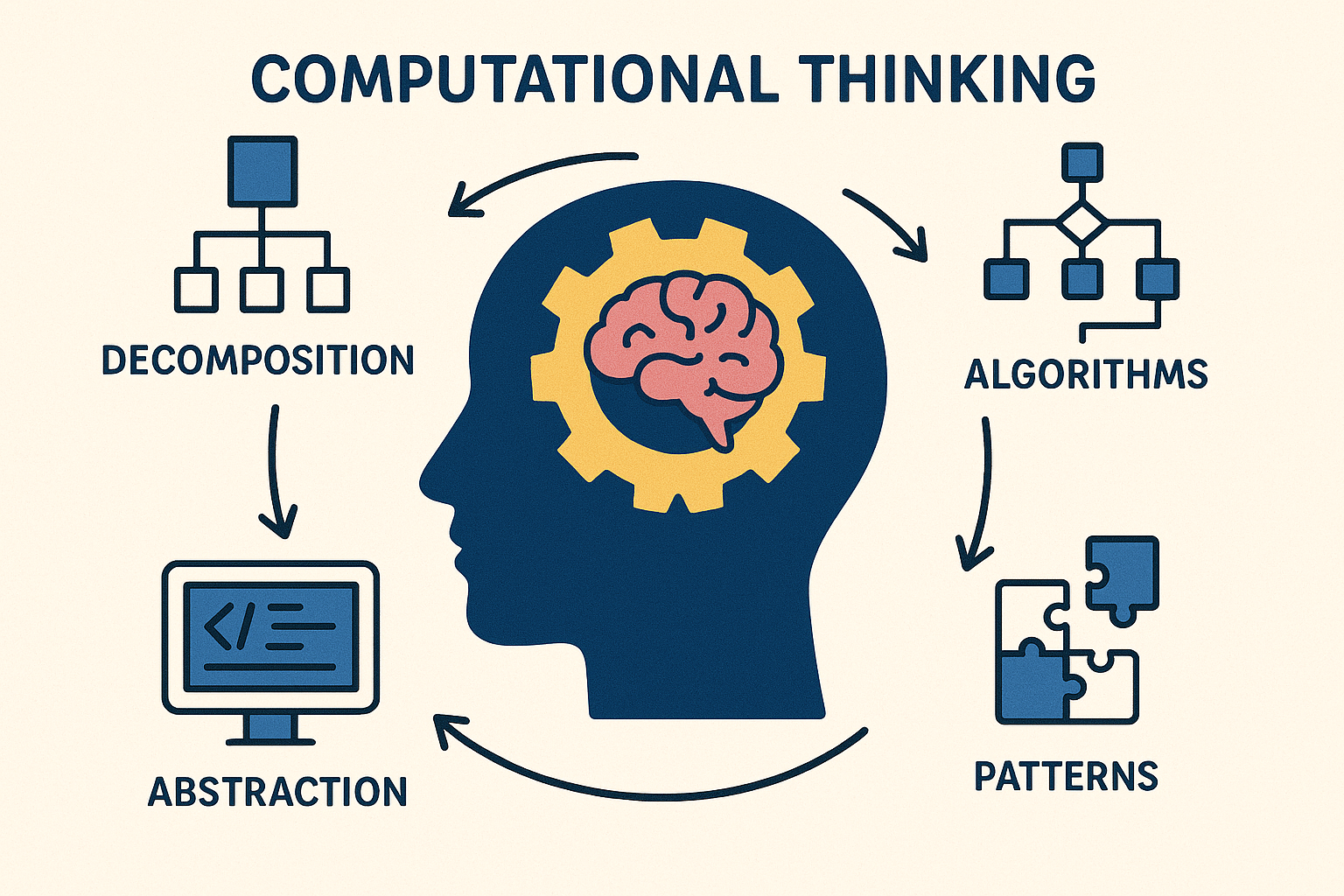
Computational Thinking
1.1.1 Know the definition and understand the purpose of computational thinking.
1.1.2 Know when to use computational thinking.
1.1.3 Know and understand the benefits and drawbacks of using computational thinking.
1.1.4 Know the components of computational thinking: decomposition, pattern recognition, abstraction, algorithmic design.
1.1.5 Know and understand the benefits and drawbacks of using the components of computational thinking.
Computational Thinking Explainer Video by NotebookLM
1.1.1 Purpose of Computational Thinking
Computational thinking is a problem-solving process that involves breaking down complex problems into manageable parts and developing logical solutions that can be carried out by a human or a computer. Computational thinking equips individuals with a structured approach to tackle problems in a way that is precise, efficient, and replicable.
The purpose of computational thinking is to simplify complex problems so they can be more easily understood and addressed. By breaking problems down into manageable parts, it becomes easier to identify patterns, focus on key details, and develop effective solutions.
It also enables the design of logical, step-by-step solutions that can often be automated by computers. This structured approach ensures that processes are clear, efficient, and reliable, making them suitable for implementation in digital systems.
Computational thinking also supports digital literacy by helping learners and professionals engage with technology in a more informed and confident way. It encourages a deeper understanding of how systems work, rather than just how to use them.
Computational thinking develops transferable skills such as problem-solving, critical thinking, and logical reasoning. These skills are valuable not only in computing but also in a wide range of technical and non-technical contexts.
1.1.2 When to Use Computational Thinking
Computational thinking is particularly useful when dealing with complex problems that cannot be solved in a single step. In these situations, it helps break the problem down into smaller, more manageable parts, making it easier to understand and solve systematically.
It is also essential when creating algorithms or writing code to automate tasks. By thinking in a logical, step-by-step way, solutions can be clearly defined and executed by a computer with accuracy and consistency.
In system and software design, computational thinking plays a key role in ensuring that user inputs are processed into clear and meaningful outputs. This structured approach helps developers design systems that are reliable and efficient.
Computational thinking is valuable when working with data-driven tasks such as identifying patterns, classifying information, or making predictions. It enables a more analytical approach to handling data and drawing conclusions.
It is also highly effective when debugging or optimising processes, whether in digital systems or real-world scenarios. By analysing each step logically, errors can be identified and improvements can be made.
1.1.3 Benefits and Drawbacks of Computational Thinking
Computational thinking offers several important benefits, particularly in how it strengthens problem-solving skills. By encouraging a logical and structured approach, it helps individuals break down complex problems and tackle them in a clear, methodical way. This often leads to more efficient solutions, as reusable patterns and strategies can be identified and applied to similar problems in the future.
It also supports creativity, as designing and optimising processes often requires innovative thinking within a structured framework. Computational thinking promotes precision, reducing ambiguity and ensuring that solutions are clearly defined. It encourages persistence, as solutions are rarely perfect on the first attempt and often require testing, evaluation, and refinement.
However, in some situations, this approach can be too rigid, particularly when problems require emotional awareness, intuition, or subjective judgement rather than purely logical reasoning. It can also be time-consuming to apply, especially for simple tasks where a structured approach may be unnecessary.
Computational thinking also requires a certain level of training and practice, which can be a barrier for those who are unfamiliar with logical thinking or programming concepts. It is not always the most appropriate approach, particularly for routine or well-defined tasks where simpler methods may be more efficient.
1.1.4 Components of Computational Thinking
Decomposition is the process of breaking a complex problem into smaller, more manageable parts. By dividing a large task into simpler components, it becomes easier to understand each element and work through the problem in a structured way.
Pattern recognition involves identifying similarities, trends, or regularities within data or across different problems. By recognising patterns, it becomes easier to understand how certain elements are related and to apply existing knowledge to new situations.
Abstraction is the process of filtering out unnecessary detail so that attention can be focused on the most important aspects of a problem. By ignoring irrelevant information, it becomes easier to understand the core issue and develop a clear solution without being overwhelmed by complexity.
Algorithmic design is the process of developing a clear, step-by-step strategy to solve a problem or perform a task. It involves organising actions in a logical sequence so that a solution can be followed consistently, whether by a person or a computer.
1.1.5 Benefits and Drawbacks of Components
Decomposition makes complex problems feel less overwhelming. It also allows tasks and responsibilities to be distributed more effectively, which is particularly useful in team-based projects. Working on smaller components makes it easier to test, debug, and refine solutions, as issues can be identified and addressed at a more detailed level.
However, decomposition can be difficult to clearly define the boundaries between sub-problems, especially in more complex systems. If decomposition is not done carefully, it may lead to gaps where parts of the problem are missed or overlap where the same work is repeated unnecessarily.
Pattern recognition helps predict future outcomes based on past data. This can be particularly useful in areas such as data analysis and decision-making. It also reduces repetition, as previously developed solutions can be reused when similar patterns are identified, saving time and effort.
However, patterns can be misleading if the data is inconsistent, incomplete, or biased, which may lead to incorrect conclusions. An over-reliance on patterns can cause important outliers or exceptions to be overlooked, even though these may be significant in understanding the full picture.
Abstraction simplifies problem-solving, allowing individuals to concentrate on what really matters. It also makes solutions more general and adaptable, meaning they can be applied to a wider range of similar problems rather than being limited to a single specific case.
However, if too much detail is removed, there is a risk of overlooking critical information that could affect the outcome. Abstraction requires experience and judgement to decide what can be safely ignored, which can be challenging for those who are still developing their understanding of a problem domain.
Algorithmic design ensures solutions are logical, structured, and testable. Because each step is clearly defined, it becomes easier to check for accuracy and identify where errors may occur. Algorithms can also be automated and reused, making them efficient for repeated tasks and scalable across different applications.
However, algorithmic design may require long or deeply nested algorithms, which can become difficult to manage and understand. Mistakes in the design of an algorithm are not always obvious and can be hard to detect, especially if they only appear under certain conditions or inputs.